
A DIY toran is a decorative door hanging you can make from mango leaves, flowers, paper, fabric, felt, beads, bells, wool or macrame cord, tied along a ribbon or strip as wide as your door frame. Most handmade torans take 30 minutes to 3 hours and cost ₹50 to ₹500 in materials. Fresh leaf and flower torans last two to four days, while fabric, felt, bead and macrame torans can be reused for years.

Below you will find how to measure your door, which base and materials to choose, 15 toran ideas with steps and measurements, toran ideas for each occasion, and how to hang a toran without nails.
What is a toran?
A toran (also called bandhanwar in Hindi and thoranam or thoran in South India) is a decorative hanging fixed across the top of a doorway. In Hindu homes it is hung on the main door during festivals, weddings and housewarmings as a sign of welcome and good fortune. Fresh mango (aam) leaves and marigolds are the most traditional materials, and in Kerala, torans woven from tender coconut leaves are made for Onam and weddings. Today torans are also hung on mandirs, puja corners, kitchen doors and windows as everyday decor.
Before you start: size, base and materials
How to measure your door for a toran
- Measure the inner width of your door frame. A standard Indian main door is about 90 to 105 cm wide.
- Make the main strip the same width as the frame, or 5 cm shorter so it sits neatly inside it.
- Keep the hanging part (the drop) 15 to 25 cm deep so it does not brush tall visitors.
- If you want side hangings (latkans), make them 40 to 60 cm long and hang one at each end.
| Door | Main strip length | Drop |
|---|---|---|
| Single main door | 90–100 cm | 15–25 cm |
| Double door | 150–180 cm | 20–30 cm |
| Mandir or puja cabinet | 40–60 cm | 8–12 cm |
| Window | Window width | 10–15 cm |
Choosing a base
| Base | Works best for | Notes |
|---|---|---|
| Satin or grosgrain ribbon (2–4 cm wide) | Paper, flower, bead and felt torans | Cheap and light; fold the ends over to make hanging loops |
| Fabric strip or lace | Saree, embroidery and gota torans | Hem the edges or use fabric glue |
| Cardboard strip covered with fabric | Heavier torans with mirrors or motifs | Stays straight and does not sag in the middle |
| Strong thread or nylon line | Fresh leaf and flower torans | Use a double strand for weight |
| Wooden dowel | Macrame and woollen torans | Hangs straight and looks modern |
Toran materials compared
| Material | Lasts | Washable | Best for |
|---|---|---|---|
| Fresh mango leaves and flowers | 2–4 days | No | Festivals, pujas, weddings |
| Dried flowers | Several months | No | Everyday and minimalist decor |
| Paper and crepe paper | One or two seasons | No | Kids, school, quick festival decor |
| Felt | Years | Spot clean | No-sew, bright designs |
| Fabric, embroidery, gota | Years | Hand wash | Traditional and wedding torans |
| Beads, bells, pearls | Years | Wipe clean | Main door and mandir |
| Wool and macrame cord | Years | Hand wash | Boho and everyday decor |
Natural and flower torans
1. Folded mango leaf toran
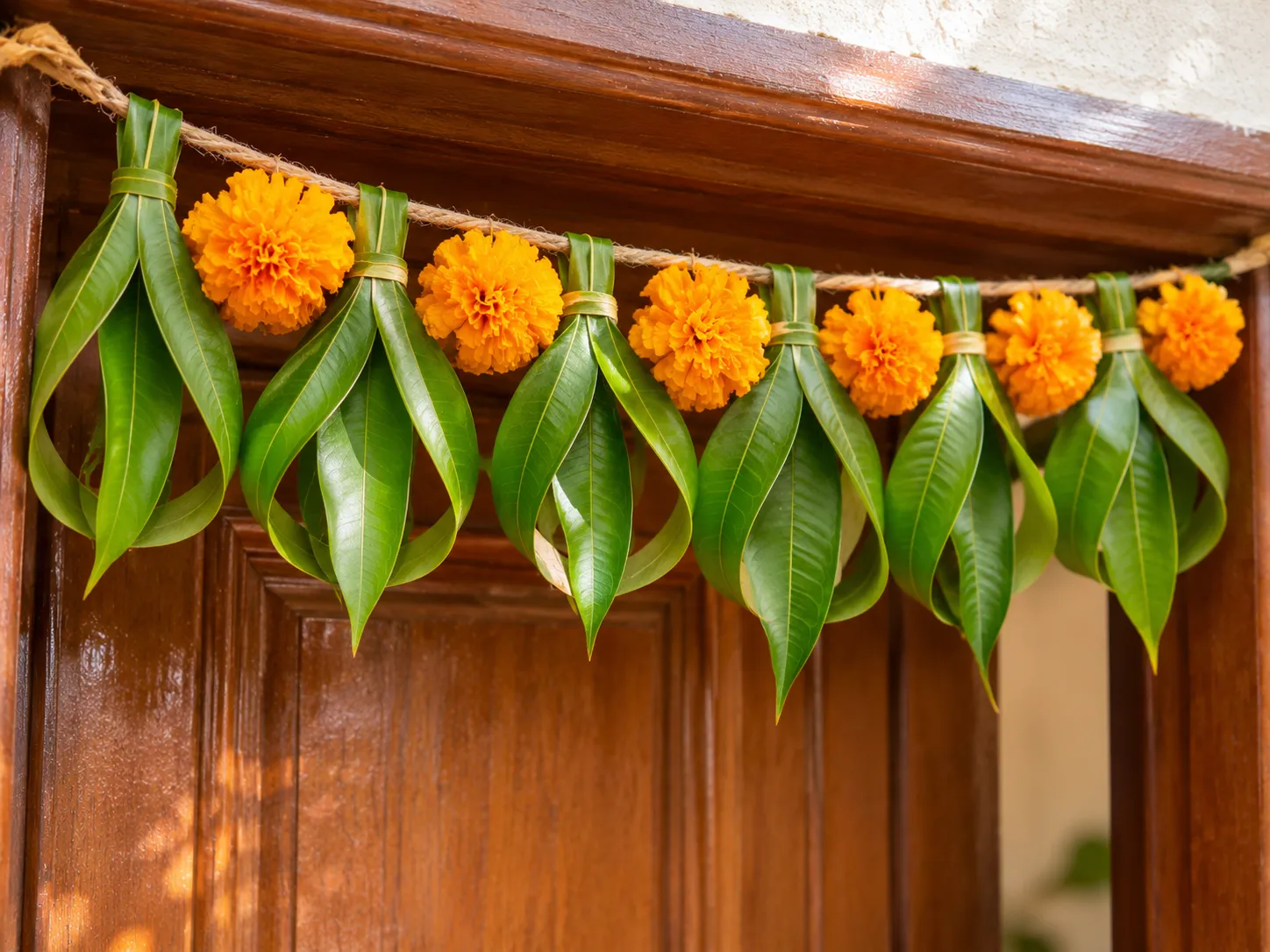
Time 45 minutesLength 1 mMaterial cost ₹30–80Skill Easy
This style folds each leaf instead of piercing it, so the leaves sit in a neat, overlapping row. For a strung marigold and mango-leaf toran, see our DIY Diwali decoration ideas.
- Collect 25 to 30 fresh, unblemished mango leaves and wipe them clean.
- Fold the tip of each leaf back towards its stem to make a loop, and pin it with a short piece of its own stem or a small stapler pin.
- Slide the loops onto a double strand of strong thread or jute twine, about 1.5 times the width of your door.
- Push the leaves close together so they overlap, and add a marigold head between every third leaf.
- Tie the ends into loops and hang the toran across the door frame.
2. Coconut leaf thoranam
Time 1 hourLength 1 mMaterial cost ₹50–100Skill Medium
Kerala’s traditional thoranam is cut from the pale yellow tender coconut leaf (kuruthola). Split the leaflets from the midrib, then make diagonal cuts and folds along each leaflet to form a fringe of triangles or tiny pockets. Tie the folded leaflets side by side along a string. It suits Onam, weddings and temple-style entrances.
3. Dried flower toran
Time 1 hourLength 1 mMaterial cost ₹200–500Skill Easy
Hot-glue small bunches of dried flowers such as statice, gypsophila, lavender and dried rose buds onto a jute-covered cardboard strip, overlapping the bunches so the stems are hidden. Add a few strands of dried pampas or wheat hanging below. A dried flower toran stays colourful for months and suits modern and minimalist homes.
Paper and craft torans
4. Crepe paper rose toran
Time 1.5 hoursLength 1 mMaterial cost ₹80–150Skill Easy
- Cut crepe paper into strips 5 cm wide and 40 cm long, with the grain running across the width.
- Fold the top edge down by 1 cm, then roll the strip tightly at one end to make the centre and loosely along the rest, pinching the base as you go.
- Stretch the folded edge slightly as you roll to make the petals curl outward.
- Make 10 to 12 roses in two colours and glue them along a ribbon, adding paper leaves between them.
- Hang short strings of paper beads or tassels below each rose.
5. Paper fan and tassel toran
Time 1 hourLength 1 mMaterial cost ₹50–100Skill Very easy
Make small paper fans by accordion-folding 10 × 15 cm strips of paper into 1 cm pleats and gluing them at the base. Make tassels by cutting fringes into tissue paper and rolling them up. Glue the fans along a ribbon, about 8 cm apart, and hang a tassel below each one. This is one of the best torans for children and school projects.
6. Cardboard Ganesha toran
Time 2 hoursLength 1 mMaterial cost ₹100–200Skill Medium
Cut a 1 m strip of cardboard 8 cm wide and cover it with red or yellow fabric. In the centre, glue a Ganesha shape cut from felt or drawn on card and outlined with gold glitter or gota. Fill the rest of the strip with paper or felt flowers, add bells at the bottom edge, and hang two 50 cm latkans at the ends. It suits Ganesh Chaturthi and griha pravesh.
Fabric, felt and embroidery torans
7. Old saree triangle toran
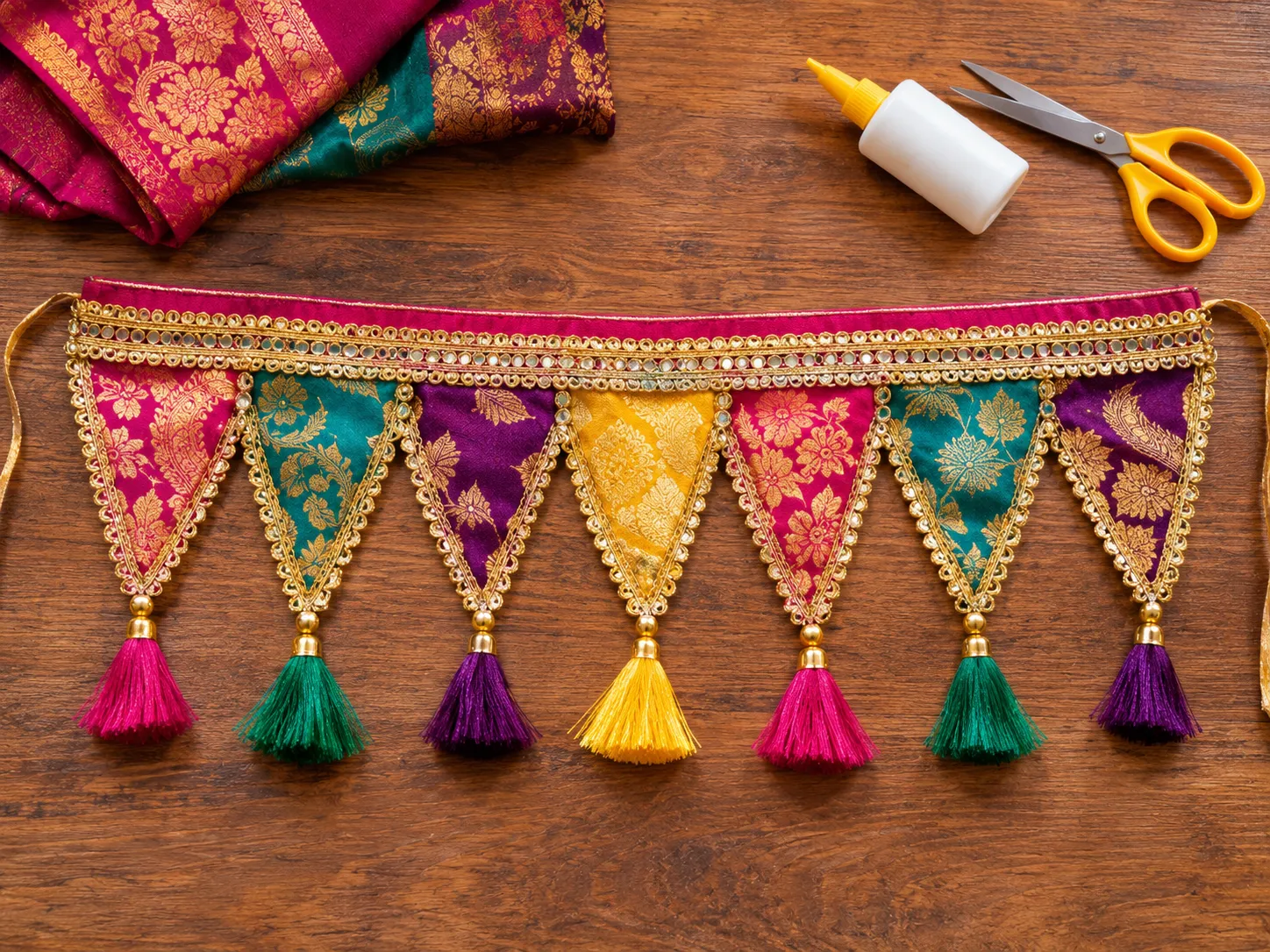
Time 1.5 hoursLength 1 mMaterial cost ₹0–50Skill Easy
- Cut 9 to 11 triangles from an old saree or dupatta, each about 12 cm wide at the top and 18 cm long.
- Fold the side edges under by 0.5 cm and fix them with fabric glue or iron-on hem tape.
- Fold a 3 cm-wide ribbon or bias strip over the top edge of each triangle and stitch or glue it, spacing the triangles 1 cm apart.
- Add a tassel, bell or small pom-pom at each triangle tip.
Borders and pallu sections with zari make the most striking triangles, so plan your cuts around them.
8. No-sew felt toran
Time 1 hourLength 1 mMaterial cost ₹100–200Skill Very easy
Cut leaves, flowers and paisleys from felt sheets in green, red, orange and yellow. Layer two or three shapes for each flower and glue them with fabric glue. Glue the flowers along a felt or ribbon strip, then add sequins, mirrors or pearls at the centres. Felt does not fray, so no sewing or hemming is needed.
9. Mirror-work and gota patti toran
Time 2–3 hoursLength 1 mMaterial cost ₹200–400Skill Medium
On a 10 cm-wide strip of red or green cotton, glue a row of round mirrors (abhla) spaced 6 cm apart, then frame each mirror with a ring of gota patti (gold ribbon trim). Add triangles or scallops of the same fabric along the bottom edge, each finished with a tassel or ghungroo bell. This is the classic Gujarati and Rajasthani toran style.
10. Woollen pom-pom toran
Time 1.5 hoursLength 1 mMaterial cost ₹100–150Skill Easy
- Wrap wool yarn about 40 times around the tines of a fork.
- Tie a separate piece of yarn tightly through the middle gap of the fork, around the wound yarn.
- Slide it off, cut through the loops on both sides and fluff it into a ball. Trim it even.
- Make 12 to 15 pom-poms in bright colours and tie them along a strand of wool or a ribbon, alternating with tassels.
Bead, bell and thread torans
11. Bead and ghungroo toran

Time 2 hoursLength 1 mMaterial cost ₹150–300Skill Medium
- Tie hanging strands to a ribbon or cord every 5 cm, each about 15 to 20 cm long, using nylon beading thread.
- Thread beads onto each strand in a repeating pattern, for example three small beads, one large bead.
- Finish each strand with a ghungroo (small bell) and secure it with a double knot and a dot of glue, or a crimp bead.
- Make the strands slightly longer in the middle to give the toran a gentle V-shape.
12. Mauli thread tassel toran
Time 1 hourLength 60 cmMaterial cost ₹50–100Skill Easy
Mauli (kalava) is the red and yellow sacred thread tied at pujas. Wrap it 30 times around a 10 cm card, tie the top, cut the bottom loops and bind the neck to make a tassel. Make 10 to 12 tassels and tie them along a mauli cord with a small bell between each. It is a simple, meaningful toran for a mandir or puja corner.
13. Macrame toran
Time 2–3 hoursLength 60–90 cmMaterial cost ₹250–500Skill Medium
- Cut 16 lengths of 3 mm macrame cord, each 2 m long, and attach them to a 60 to 90 cm wooden dowel with lark’s head knots.
- Tie a row of square knots across all the cords, then a second row with alternating square knots to make a net pattern.
- Shape the bottom into a V by tying fewer knots on each row towards the centre.
- Trim the fringe and add wooden beads or small brass bells.
14. Pearl and kundan toran for weddings
Time 2–3 hoursLength 1 mMaterial cost ₹300–500Skill Medium
On a gold brocade strip, glue a row of large kundan stones 8 cm apart and connect them with swags of pearl string. Hang short pearl strands with a small kundan drop below each stone. It works for mehndi, haldi and engagement entrances and can be reused for every family wedding.
Upcycled torans
15. Bangle toran
Time 1.5 hoursLength 1 mMaterial cost ₹0–100Skill Easy
Wrap old glass or metal bangles tightly with colourful thread or wool, gluing the start and end. Decorate each bangle with a mirror, a paper flower or beads in the centre, and tie them side by side along a ribbon, with tassels hanging below. Each bangle frames its decoration like a small medallion.
Toran ideas by occasion
| Occasion | Toran idea | Colours |
|---|---|---|
| Diwali | Folded mango leaf, mirror and gota, bead and bell | Red, gold, green |
| Wedding, mehndi and haldi | Pearl and kundan, marigold strings, saree triangles | Yellow, orange, pink and gold |
| Griha pravesh | Mango leaf with marigold, Ganesha toran | Green, yellow, red |
| Ganesh Chaturthi | Cardboard Ganesha, paper fan toran | Red, yellow, green |
| Navratri | Mirror-work, pom-pom and tassel torans | Bright multicolour |
| Onam | Coconut leaf thoranam, flower torans | Yellow, white, green |
| Everyday and modern homes | Dried flower, macrame, felt | Neutrals with one accent |
| Mandir and puja corner | Mauli tassel, bead and bell | Red and gold |
A toran pairs naturally with a rangoli at the doorstep; our guide to rangoli designs for beginners covers easy designs for entrances.
How to hang a toran
On a wooden door frame
Fix two small brass cup hooks or panel pins, one at each top corner of the frame, and hang the toran by its end loops. For a long or heavy toran, add a third hook in the middle to stop it sagging.
Without nails (for renters)
- Adhesive hooks: use two removable hooks rated for at least double the toran’s weight, and press each one firmly for 30 seconds on a clean, dry surface.
- Tension rod: fit a slim tension rod inside the door frame and tie the toran to it. Nothing touches the wall.
- Double-sided tape: only for very light paper or felt torans; it can peel paint when removed.
- Door top clips: over-the-door hooks slide on the top of the door itself and hold light torans.
Placement tips
- Centre the toran on the frame and check it is level from both ends.
- Leave at least 1.9 m of clear height below the toran so tall visitors can walk through.
- Many families follow the tradition of hanging the toran on the main entrance from the outside, facing guests.
- Hang fresh leaf torans out of direct afternoon sun so they stay green longer.
Caring for and storing your toran
- Replace fresh mango leaf torans when the leaves start to dry, usually after two to four days.
- Shake dust off fabric and bead torans every few weeks; spot clean fabric with a damp cloth.
- Hand wash cotton torans in cold water if the dyes are colourfast, and dry them flat in the shade.
- Store torans rolled around a cardboard tube or laid flat, with tissue between layers so mirrors and beads do not scratch each other.
Common toran mistakes
| Mistake | Fix |
|---|---|
| Toran sags in the middle | Use a stiffer base or add a middle hook |
| Too long, brushes heads | Keep the drop to 15–25 cm |
| Hangings tangle in the wind | Space strands 5 cm apart and add small weights such as bells |
| Fresh leaves dry in a day | Hang it the evening before the festival, away from direct sun |
| Adhesive hooks fall off | Clean the surface with alcohol first and check the weight rating |
Frequently asked questions
How do I make a simple toran at home?
Tie 25 to 30 fresh mango leaves or paper leaves along a strong thread or ribbon as wide as your door, add a marigold or paper flower between every few leaves, and hang it with two hooks at the top corners of the frame. It takes about 45 minutes.
What is a toran used for?
A toran decorates the top of a doorway. In Hindu tradition it is hung on the main door during festivals, weddings and housewarmings as a symbol of welcome and good fortune.
Why are mango leaves used in torans?
Mango leaves are considered auspicious in Hindu tradition and are linked with prosperity and new beginnings. They also stay green for a few days after picking, which makes them practical for festival torans.
What size should a toran be?
Make the main strip about the same width as the inner door frame (90 to 100 cm for most single doors) and keep the hanging part 15 to 25 cm deep. Side hangings are usually 40 to 60 cm long.
How do I hang a toran without drilling?
Use removable adhesive hooks rated for the toran’s weight, a tension rod inside the door frame, or over-the-door hooks. Double-sided tape is only suitable for very light paper torans.
Which toran lasts the longest?
Fabric, felt, bead, dried flower and macrame torans last for years. Fresh leaf and flower torans last only two to four days.
What is the difference between a toran and a bandhanwar?
They are the same thing. Toran is the common term across India, while bandhanwar is widely used in Hindi-speaking regions, especially for torans with hanging strands.


